How to Earn Income While the Cocoa Trees Grow
Growing Ginger
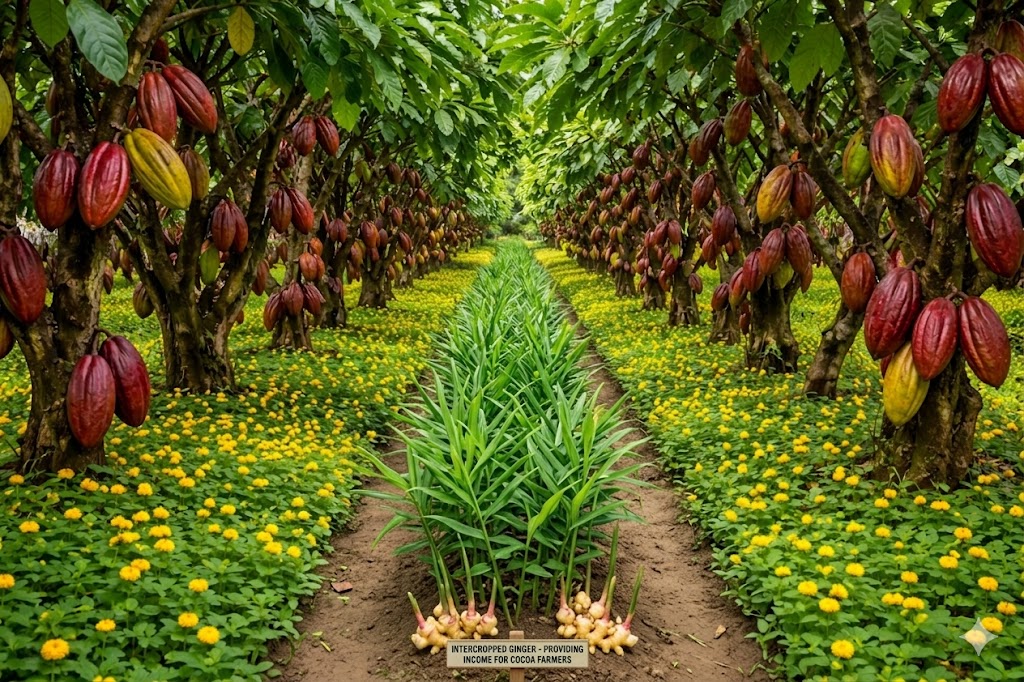
Ginger is indeed an excellent choice because it is high-value, shade-tolerant, and has a relatively short growth cycle (8–10 months). However, farmers often use a “multi-tier” approach to maximize different harvest windows.
1. Highly Profitable Intercrops for Cocoa
Crop Type | Examples | Economic & Agronomic Benefit |
Short-Term (Annuals) | Ginger, Turmeric, Chili Peppers | High market value per kg; ginger and turmeric thrive in the filtered shade under cocoa. |
Fruit & Shade | Banana/Plantain, Papaya | Provides the critical 50% shade young cocoa needs while offering a steady weekly or monthly income. |
Staple Food Crops | Cassava, Sweet Potato, Maize | Essential for food security; can be sold locally to cover immediate labor costs. |
Legumes | Cowpea, Groundnuts, Mung Beans | Improves soil health by fixing nitrogen, reducing the need for expensive chemical fertilizers. |
Long-Term Upper Storey | Coconut, Arecanut, Rubber | Creates a “permanent” income stream; cocoa acts as the understorey crop in this established system. |
2. Why Ginger is a Top Choice
Shade Tolerance: Ginger naturally prefers 30% to 50% shade, which matches the environment under young cocoa or within an agroforestry setup.
Vertical Space: Since ginger is a rhizome (growing underground), it doesn’t compete for vertical space with the cocoa canopy.
Storage: Unlike soft fruits, ginger can be “stored” in the ground for a few extra months if market prices are low, giving farmers more leverage.
3. Management Tips for Intercropping
Nutrient Competition: Ginger is a heavy feeder. Ensure you are applying enough organic fertilizer to support both the ginger and the developing cocoa root systems.
Spacing: Maintain a clear “drip line” around the cocoa base (roughly 1 meter) to prevent the intercrops from crowding the tree’s primary feeding roots.
Watering: In regions with a distinct dry season, the water demand for a dense intercrop like ginger may require supplemental irrigation to ensure the cocoa doesn’t get stressed.
Cocoa Trees Intercropped with Sweet Potatoes
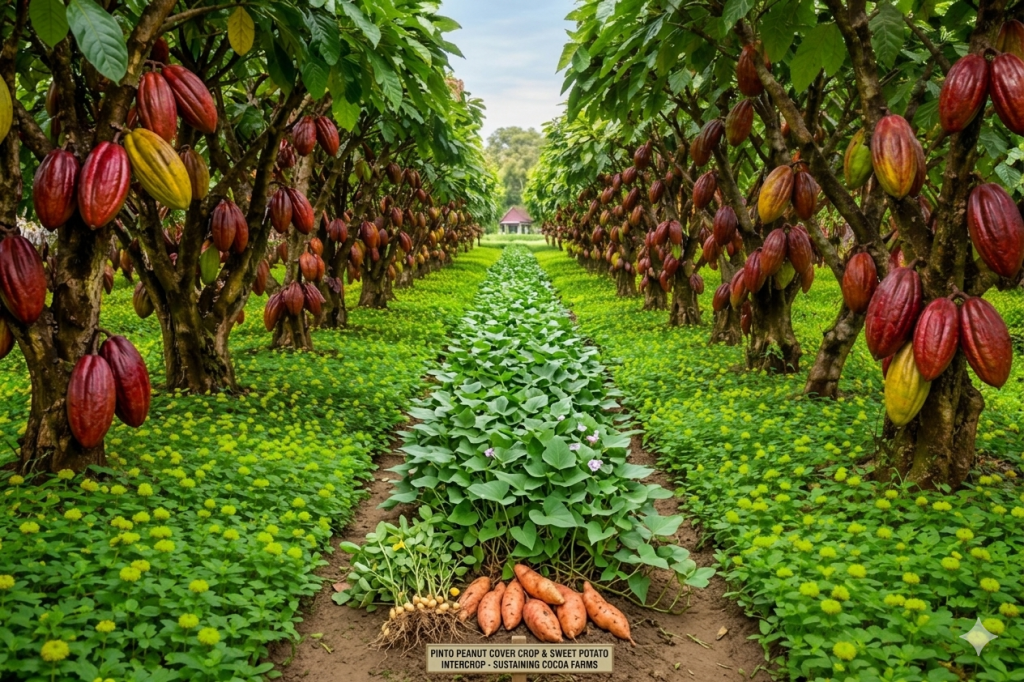
uIntercropping cocoa with sweet potatoes offers a blend of immediate financial returns and long-term agronomic health. While the pinto peanut provides a permanent “living carpet,” adding sweet potatoes into the center row creates a highly productive multi-layer system.
Here are the primary benefits of this combination:
1. Rapid “Gap” Income
Cocoa trees are a long-term investment, often taking years to reach peak profitability. Sweet potatoes are a short-cycle crop (usually 3–5 months). This allows farmers to generate revenue or a food source several times a year while the cocoa canopy is still closing.
2. Superior Weed Suppression
While pinto peanut is excellent for suppressing weeds, sweet potatoes have large, broad leaves and a rapid crawling growth habit. By planting them in the center row, you effectively “choke out” sunlight from any stubborn annual weeds that might try to compete for nutrients in the middle of the alley.
3. Soil Moisture and Temperature Regulation
The dense foliage of sweet potatoes acts as a secondary thermal blanket for the soil.
It reduces evaporation, keeping the root zones of the young cocoa trees hydrated.
It prevents the soil from over-heating during peak sunlight hours, which protects the sensitive microbial life in the topsoil.
4. Efficient Use of Light
Young cocoa trees are naturally shade-loving. Sweet potatoes can thrive in the high-light environment of the center row while the cocoa trees are small. As the cocoa canopy grows and begins to cast more shade, the sweet potato yields may decrease, but by then, the cocoa trees are usually reaching their own productive phase.
5. Soil Structure Improvement
The root systems of sweet potatoes help to aerate the soil. When the potatoes are harvested, the act of digging (if done carefully) can help break up compacted soil in the center alley, though it is important to keep this activity away from the delicate drip line of the cocoa trees.
6. Comparison of the Two Systems
Feature | Pinto Peanut Only | Cocoa + Sweet Potato + Pinto Peanut |
Primary Goal | Soil health & low maintenance. | Income generation & weed control. |
Harvest Frequency | None (it’s a permanent cover). | Every 4 months. |
Nutrient Impact | Steady nitrogen fixation. | High biomass return (vines can be composted). |
Labour | Very low (mowing 1-2 times/year). | Moderate (planting and harvesting). |